Drop Glasswall Halo into your AI agent: introducing the Halo Agent Skills package
What if your developers could protect files, configure policies and ship Halo integrations just by describing what they want, without ever opening an API doc?
Files remain one of the most consistent entry points for threats in any environment. Protecting file workflows means integrating Glasswall Halo into the tools and pipelines your teams already use, and the faster that integration happens, the shorter the window of exposure.
AI coding agents are now central to how software gets built. Developers rely on Claude, Cursor, OpenAI Codex, Gemini and others to write code, wire up services and automate workflows. But an agent is only as good as what it knows, and out of the box, it knows nothing about Glasswall Halo: which endpoint to call, how policies are structured, or that storage monitors bind to engine policies. This means teams fall back to reading documentation and working through integrations themselves.
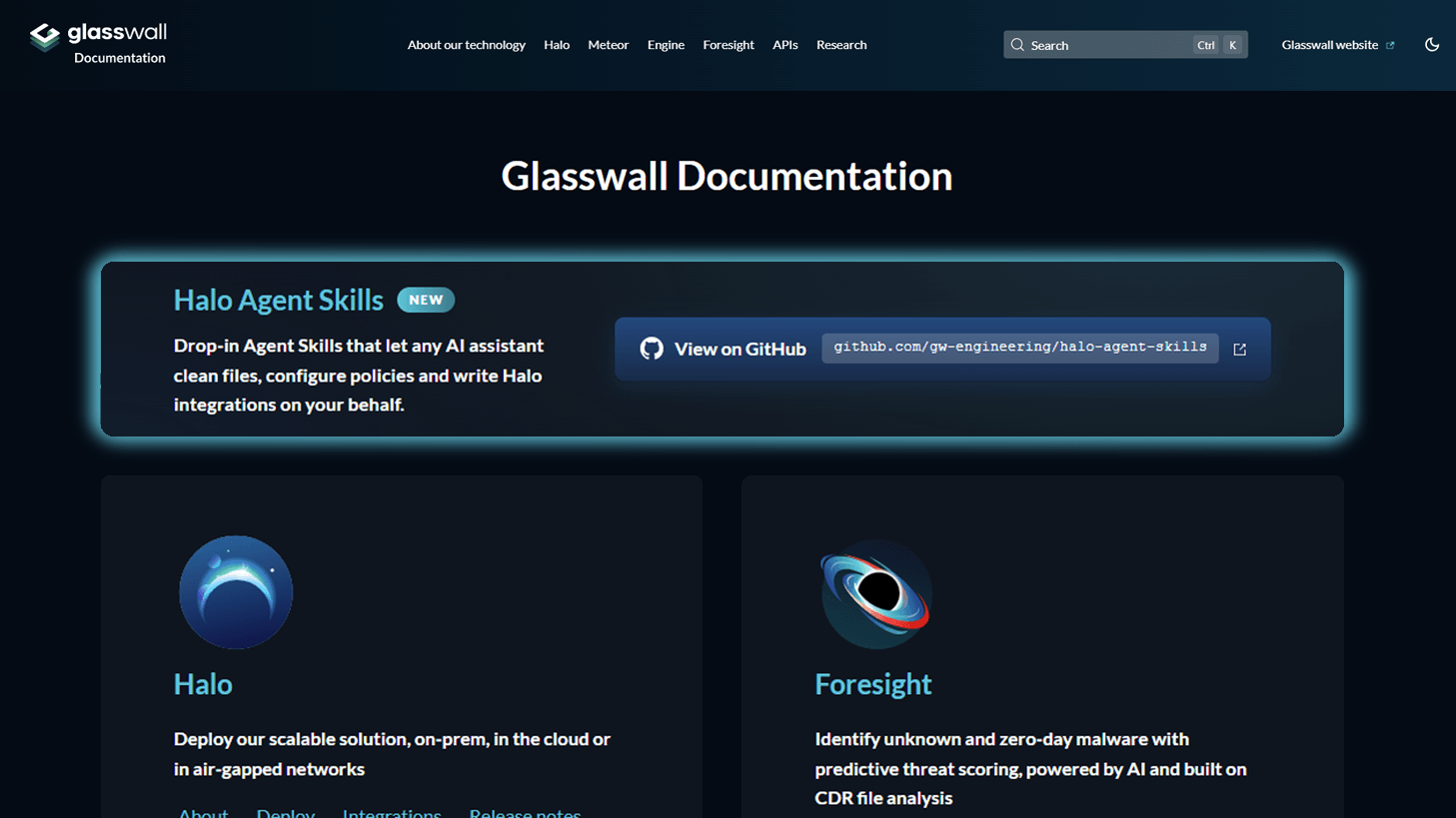
That's the gap we built the Halo Agent Skills package to close. It's now available on GitHub.
Built on the open Agent Skills standard
Agent Skills is an open standard, originally from Anthropic and now adopted across Claude Code, Cursor, Gemini CLI, GitHub Copilot, OpenAI Codex, Goose, OpenCode and more. A skill is simply a SKILL.md file plus supporting references and scripts in a folder, and any compliant agent can load it.
That makes these skills vendor-neutral. Drop them into whichever agent your team already uses, point it at your Halo deployment, and the agent picks up everything it needs to drive Halo's APIs correctly. It loads deeper reference material only when the task calls for it, so the context window stays lean.
Three skills, three high-value workflows
The package ships three skills, each covering a job your team would otherwise handle manually:
halo-protect protects a real file through Glasswall Halo's synchronous Content Disarm and Reconstruction (CDR) API. The agent submits the file, retrieves the rebuilt version and analysis report, and surfaces the verdict. Just say "clean this document with Halo."
halo-policy-config configures a running Glasswall Halo deployment via its admin APIs, covering engine policies, ICAP profiles, XML validation, and storage monitors for SharePoint, OneDrive and Outlook. Describe the policy you want in plain English and the agent drafts the call, shows it for your confirmation, then runs it.
halo-workflow-integration generates working integration code in Python, JavaScript, C#, curl or any other language, for apps that call Glasswall Halo as part of an ingestion or processing pipeline. "Add Halo CDR to my Express upload handler" becomes working middleware.
In each case, your team never needs to know what ICAP is, how monitors bind to policies, or which endpoint to call. The skill encodes that knowledge. This is just the start. We'll be adding more skills over time as we extend coverage across Halo's capabilities.
Why this matters
Zero prior knowledge required. Your team describes the outcome; the agent handles the API surface. No tab-switching to the docs.
Use the agent you already have. One vendor-neutral package works across every compliant tool, with no lock-in to a single assistant.
Confirm before it acts. Anything that changes a deployment is shown for approval before it runs, so an agent never mutates your configuration unseen.
Runs your way, against your deployment. Built strictly from Halo's published API contract, with interchangeable Python, bash, Node and .NET runtimes that run against your own Halo instance.
How it works
Install once. Copy the three skill folders into your agent's skills directory. For Claude Code that's .claude/skills/; other tools define their own paths, but the content stays the same.
Point at Halo. Give the agent your deployment URL and a token so it can talk to your Halo instance.
Just ask. Describe what you want, whether that's protecting a file, changing a policy or generating an integration, and the agent activates the right skill, loads the references it needs, and gets it done.
What your team gets
Glasswall Halo protects organizations from file-borne threats using CDR, rebuilding every file to a known-good standard so both known and novel threats are removed before they can reach users. The Halo Agent Skills package makes that protection faster to adopt. Your developers spend less time in documentation and less time working through integration details. The work of choosing the right endpoints and producing correct code happens inside the agent they already use.
The result is fewer integration mistakes and a faster path from "we should protect these files" to files actually being protected.
Sam Wharton, our AI Product Specialist, has spent more than a decade turning complex research into production AI/ML solutions across predictive analytics, NLP, and Generative AI in multiple industries. As product lead in our Applied AI team, he drives the strategy and delivery of Glasswall's AI-powered cybersecurity products.
See what Zero Trust file protection looks like. Live, in 25 minutes.
A tailored walkthrough of how Glasswall rebuilds files to a known-good state, removes hidden threats, and provides the intelligence you need to understand file risk.
What's in the demo
See malicious files rebuilt in real time Watch Glasswall remove hidden threats and return a safe, usable files.
Integrate security without disruption See how Glasswall fits into your existing workflows and infrastructure.
Gain complete visibility into file risk Uncover threats, anomalies and hidden file intelligence.
“
Beazley's security is paramount, and this integration has significantly reinforced our cybersecurity framework.
Thank you! Your submission has been received!
Oops! Something went wrong while submitting the form.

.png)




.png)
