Ask most security leaders whether their organization has file security in place and the answer is yes. Antivirus is running. Email is filtered. There’s a sandbox for anything that looks unusual. Files arriving from outside the organization are scanned, flagged or blocked, and the team has confidence that the process is working. That confidence is reasonable, and it is also one of the most dangerous assumptions in modern cybersecurity.
The problem is not that these tools are poorly built. It is that they were designed to answer the wrong question. Instead of asking whether a file is genuinely safe, they ask whether a file matches something previously identified as dangerous. For known threats, that distinction barely matters. For everything else, it is the difference between protection and exposure.
The cost of waiting to be told something is dangerous
Consider what happens when a novel piece of malware enters your environment inside a routine PDF. It has no signature because it has never been catalogued. It exhibits no behavior your sandbox recognizes because it is engineered to avoid triggering those detections. Every layer of your security stack processes it and returns a clean verdict, because from the perspective of those tools, it is clean. The employee opens it. Something executes. And the clock starts on an incident that your tools, by design, could not prevent.
This is not a theoretical scenario. According to the Fortinet Global Threat Landscape Report 2025, attackers are exploiting newly disclosed high-value vulnerabilities in an average of just 5.4 days, leaving almost no window for detection tools to catch up before active exploitation is already underway. Meanwhile, the IBM X-Force Report 2025 found that 45% of malicious email attachments are PDFs and 7.2% are MS Office files, confirming that the file formats organizations handle most routinely are precisely the ones attacker's favor. The barrier to crafting file-based threats that evade signature detection has dropped considerably, and the combination of speed and volume creates a risk profile that traditional detection tools are structurally unable to address.
Where the risk actually lives
The files that bypass detection are rarely exotic. They are the documents that employees are expected to open: supplier invoices, procurement forms, HR attachments, shared reports from clients and partners. The more trusted the source appears, the less scrutiny the file receives, which is precisely why business email compromise and supply chain attacks so often use weaponized documents as the delivery mechanism. The file is not suspicious. The relationship is established. The damage is done before anyone questions it.
The scale of this problem is significant. The CheckPoint 2025 Cyber Security Risk Report found that email remains the top initial infection vector at 68%, with PDFs and HTML the primary formats used, and approximately 341 PDF-based attack attempts made every week. The Verizon 2025 Data Breach Investigations Report adds further context, finding that around 60% of breaches involve human interaction, a reminder that security strategies which rely on employees making the right decision are working against the odds. Research presented at BlackHat 2025 by Ariana Mirian and Christian Dameff went further still, finding that phishing training is rarely effective in practice, reinforcing that the file itself needs to be assessed rather than relying on the recipient to spot the risk. For organizations in sectors like financial services, legal, defense and government, where high volumes of sensitive documents cross organizational boundaries daily, this is not a marginal risk but a central one.
What better intelligence actually looks like in practice
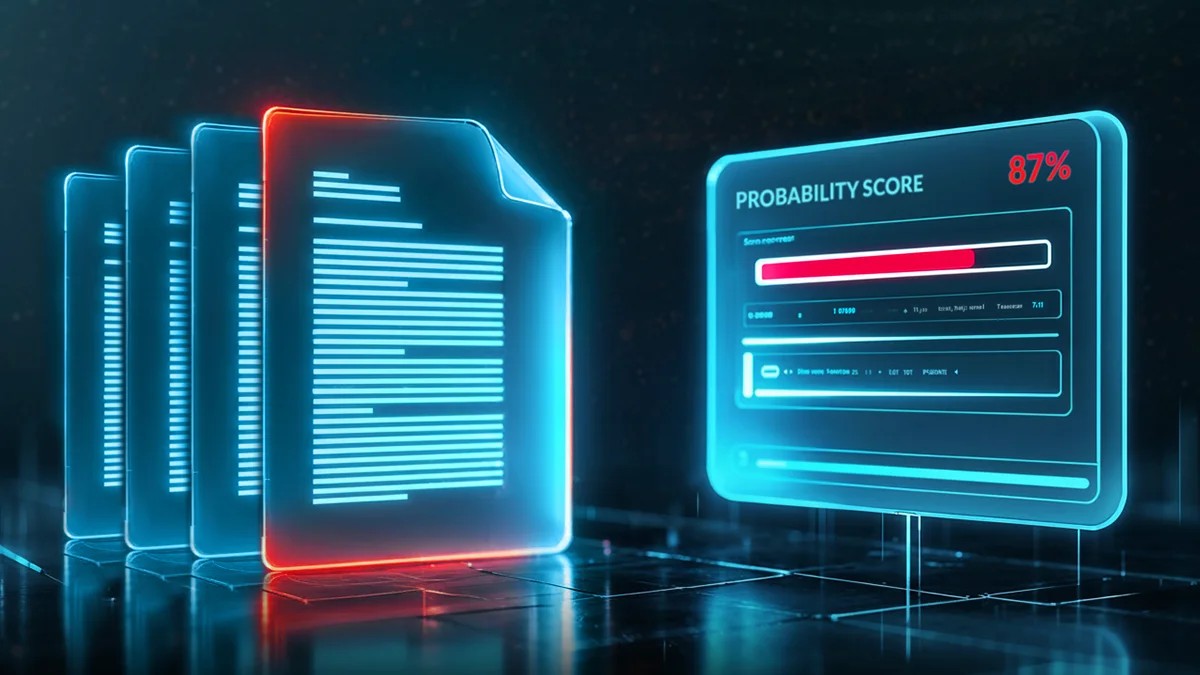
The answer to this problem is not more detection rules or faster signature updates. It is intelligence that does not depend on having seen a threat before. Glasswall Foresight approaches file security from a different starting point entirely, examining the internal structure of each file and using machine learning to generate a probabilistic assessment of whether that structure is consistent with malicious intent. Because this analysis is grounded in how files are built rather than what threats have previously been catalogued, it is capable of surfacing risk in files that carry no known indicators of compromise whatsoever.
In practical terms, this means that a security team reviewing files processed through Glasswall Meteor receives a clear risk label for each one: Malicious, Suspicious, or No Threats Detected. That label is not a binary pass or fail but a signal calibrated to the actual likelihood of harm, giving analysts the context they need to make faster, better-informed decisions without having to dig into raw file data themselves. For teams already managing significant alert volumes, that shift in how information is presented matters as much as the underlying detection capability.
The compounding value of catching threats earlier
There is a well-established principle in security that the earlier in the attack lifecycle a threat is identified, the lower the cost of responding to it. A file flagged before it reaches an endpoint costs almost nothing to handle. A breach discovered after data has been exfiltrated can cost an organization its reputation, its regulatory standing, and in some sectors, considerably more than that. Foresight operates at the point of file processing, before delivery to the end user, which means it intervenes at precisely the moment when interception is both technically straightforward and organizationally painless.
This is also where the combination with Glasswall’s CDR (Content Disarm and Reconstruction) technology becomes significant. CDR neutralizes threats by rebuilding files to a known-safe state, while Foresight adds a predictive intelligence layer that identifies risk even in files where the threat is too novel for CDR policies alone to act on. Together, they address both the known and the unknown dimensions of file-based risk, which is increasingly the standard that security-conscious organizations need to meet.
Closing the gap that attackers count on staying open
The gap between what detection tools can see and what attackers are actually doing is not a temporary problem that better tooling will eventually close. It is an inherent feature of any approach that depends on prior knowledge of threats, and the problem is accelerating. The CrowdStrike 2025 Global Threat Report found that AI-generated phishing content achieves a 54% click-through rate compared to just 12% for human-created content, and the Verizon DBIR 2025 reported that AI-generated attack emails now account for 10% of all attack emails, a figure that doubled in a single year. As the volume and sophistication of file-based threats grows, the case for intelligence that does not depend on having seen a threat before becomes harder to ignore.
That is the problem Glasswall Foresight was built to solve, and it is the gap that organizations relying solely on traditional file security tools are leaving open every day.
Our Senior Technical Writer and Product Marketing Manager, Riyya, is exceptional at authoring, organizing, and simplifying our product documentation. Using her keen eye for detail and wealth of experience in tech, Riyya helps our clients and partners seamlessly integrate with industry-leading Zero Trust CDR.
See what Zero Trust file protection looks like. Live, in 25 minutes.
A tailored walkthrough of how Glasswall rebuilds files to a known-good state, removes hidden threats, and provides the intelligence you need to understand file risk.
What's in the demo
See malicious files rebuilt in real time Watch Glasswall remove hidden threats and return a safe, usable files.
Integrate security without disruption See how Glasswall fits into your existing workflows and infrastructure.
Gain complete visibility into file risk Uncover threats, anomalies and hidden file intelligence.
“
Beazley's security is paramount, and this integration has significantly reinforced our cybersecurity framework.
Thank you! Your submission has been received!
Oops! Something went wrong while submitting the form.




.png)
