Glasswall and MindLink bring Zero Trust file security to mission collaboration
Sharing a file should help a mission move forward. In classified environments, it can also raise difficult questions. Is the content safe to open? Does it meet the receiving domain’s handling policies? Will viewing it leave a copy somewhere it should not be stored?
These are the challenges being mitigated behind Glasswall’s partnership with MindLink, the secure collaboration provider for defence and national security.
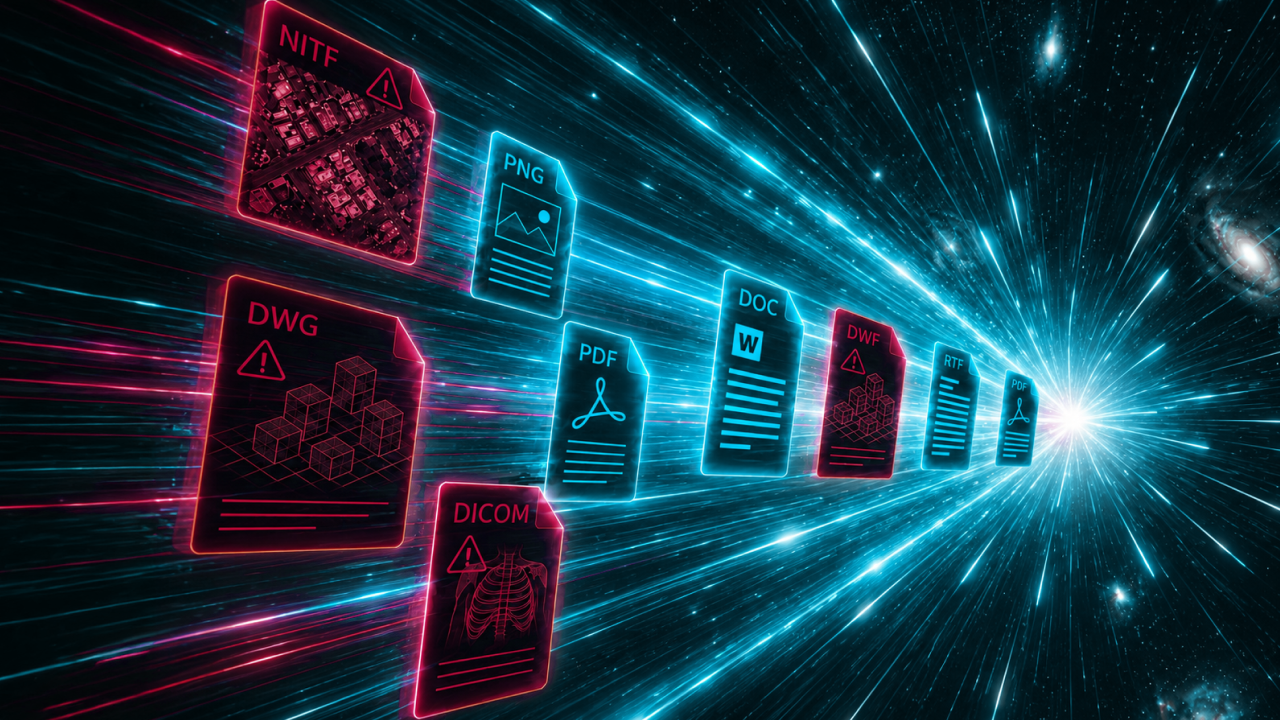
With Glasswall’s Zero Trust Content Disarm and Reconstruction (CDR) embedded in MindLink, files are rebuilt to a known good standard before they enter or leave a mission conversation. Teams can exchange the information they need, with file security built into the workflow and less need to download content to endpoints.
A secure conversation needs secure content
Documents, imagery and specialist file formats are essential to operational collaboration. But controlling who can join a conversation does not establish whether the files shared within it are safe.
Files can contain malicious structures, active content and hidden metadata. Conventional workflows can also leave downloads, cached copies and temporary files on endpoints that may not be accredited to store them.
For teams working across organisations and security domains, these risks can create a difficult tradeoff between sharing information quickly and maintaining control.
Passing a malware check does not establish that a file is safe. Teams also need assurance that its structure and content meet handling policies and that it is suitable for release into the receiving environment.
Every file rebuilt, every release verified
The integration brings file security into MindLink’s existing collaboration workflow.
MindLink assesses the user, destination room, classification and content handling attributes. Glasswall treats the file as untrusted, validates its internal structure and reconstructs a clean version containing only what policy permits.
Evidence of that process is bound to the file and verified before acceptance. Content that cannot be verified is withheld from release.
Accepted content is encrypted in storage, released only after fresh authorisation and viewed within MindLink. This reduces the need for downloads and local copies, while giving accreditors a record of assurance, authorisation, release and viewing.
Marc Robinson, CTO at Glasswall, said:
Every file entering a classified network should be treated as a potential threat, however familiar it looks. Glasswall’s Zero Trust CDR doesn’t try to recognize what is malicious. It rebuilds each file to a known good standard and keeps only what policy allows, so protection doesn’t depend on having seen the threat before. Running inside MindLink, that protection sits where defense teams actually exchange information, and it works the same way on a connected network as on one that is completely isolated.
Glasswall runs as an embedded component within MindLink, supporting deployment on premises and in disconnected, air gapped and classified networks where external services are unavailable.
Built for coalition information sharing
Coalition operations depend on timely information exchange between nations, agencies and security domains. The joint capability supports:
Mission partner environments connecting organisations across nations and agencies
Cross domain workflows transferring files between security levels
The UK’s Digital Targeting Web, where rapid information sharing requires strong assurance
NATO interoperability and secure content exchange between partners
Disconnected, air gapped and on premises environments
The capability was demonstrated at CWIX 2026, NATO’s annual interoperability exercise, showing how it supports the information flows that coalition operations depend on.
File assurance within the mission conversation
By combining MindLink’s collaboration controls with Glasswall’s file reconstruction, the partnership connects decisions about who can access information with assurance about the content they receive.
Luke Terry, CTO at MindLink, said:
Secure collaboration has often stopped short at the attachment, despite innovations in Zero Trust principles and data centric security. With Glasswall built into MindLink, every document is rebuilt before anyone opens it, and the evidence sits alongside the conversation for accreditors to check. Detection isn’t enough and has to be followed by action. Now teams can share what the mission needs without stepping outside the conversation to do it.
See the joint capability in action at NATO Edge 26 in İzmir, Türkiye, from 17 to 19 November 2026, on Booth B59.
Glasswall’s Marketing Director, Jake, brings more than a decade of expertise in file-based threats, Content Disarm and Reconstruction (CDR), and the security challenges facing government and enterprise organizations. He focuses on turning complex cybersecurity issues into practical insights that help organizations understand and reduce risk at the file level.
See what Zero Trust file protection looks like. Live, in 25 minutes.
A tailored walkthrough of how Glasswall rebuilds files to a known-good state, removes hidden threats, and provides the intelligence you need to understand file risk.
What's in the demo
See malicious files rebuilt in real time Watch Glasswall remove hidden threats and return a safe, usable files.
Integrate security without disruption See how Glasswall fits into your existing workflows and infrastructure.
Gain complete visibility into file risk Uncover threats, anomalies and hidden file intelligence.
“
Beazley's security is paramount, and this integration has significantly reinforced our cybersecurity framework.
Thank you! Your submission has been received!
Oops! Something went wrong while submitting the form.